

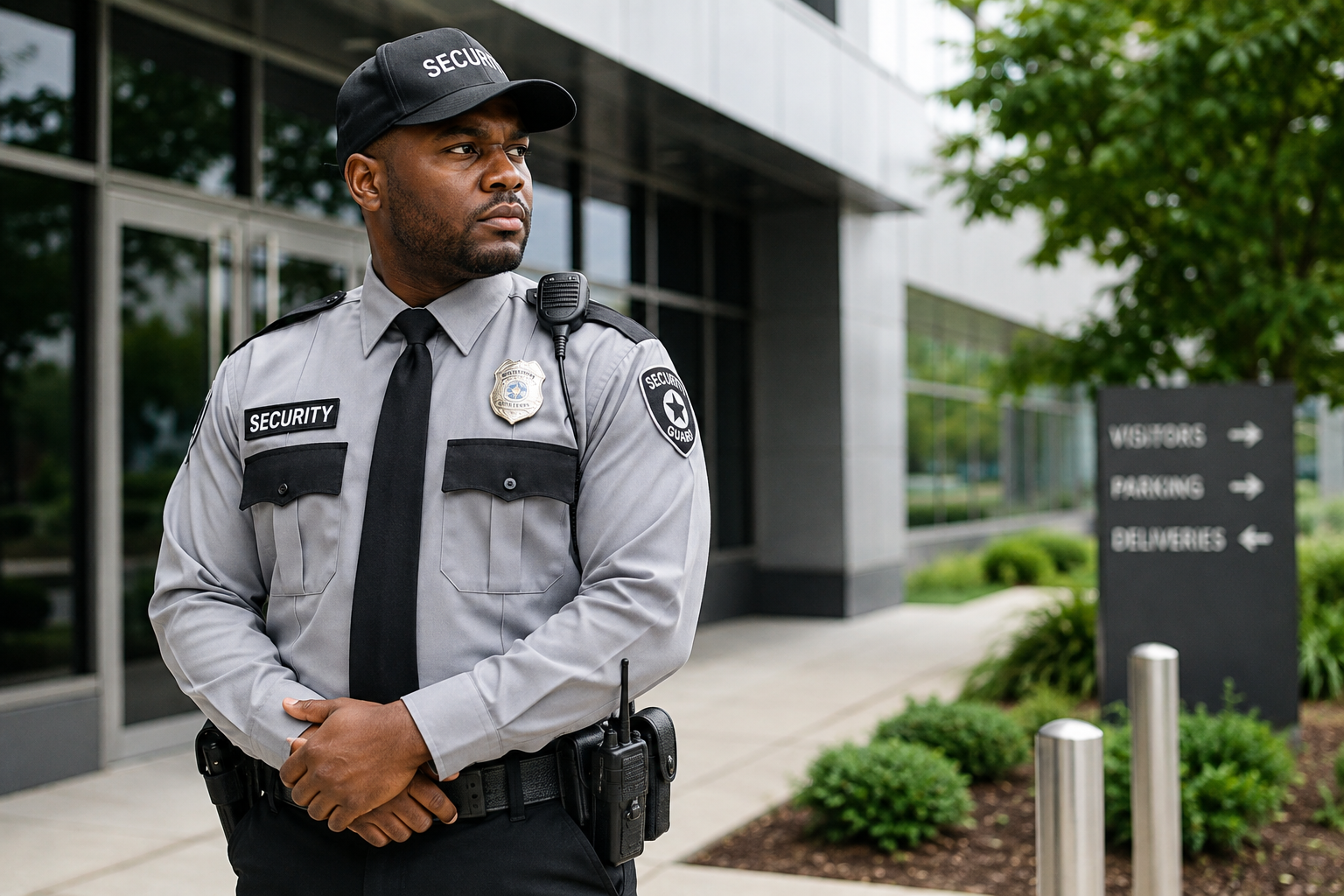
If you manage a commercial building, corporate campus, government-adjacent facility, or any property where security presence matters you have likely been asked whether you need uniformed security guards. This guide explains exactly what uniformed security guard services are, who needs them in Virginia, what a qualified provider looks like, and what to ask before you sign a contract.
In This Guide
- What Are Uniformed Security Guard Services?
- Uniformed vs. Plainclothes Security: What Is the Difference?
- Who Needs Uniformed Security Guards in Virginia?
- What Uniformed Security Guards Actually Do
- Virginia Licensing Requirements
- How to Choose a Provider
- Frequently Asked Questions
What Are Uniformed Security Guard Services?
Uniformed security guard services refer to the deployment of trained, licensed security personnel who wear a clearly identifiable uniform while on duty. The uniform is not just a dress code it is a strategic tool. Visible security presence deters incidents before they happen, signals to visitors and staff that the environment is actively monitored, and provides clear points of contact in an emergency.
In Virginia, uniformed security guards are used across a wide range of environments: commercial office buildings, corporate headquarters, retail centers, residential communities, government contractor facilities, healthcare campuses, and event venues. The common thread is that these environments benefit from security that is seen, not just present.
Uniformed security guard services typically include some combination of:
Static posts: Guards stationed at entry points, reception areas, lobbies, loading docks, or perimeter checkpoints. Static posts control who enters and exits and create a continuous visible deterrent.
Roving patrols: Guards moving through a defined area on a set schedule or randomized route. Patrols are used to monitor larger footprints, parking structures, outdoor areas, multi-building campuses that a single static post cannot cover.
Access control: Guards verifying credentials, managing visitor logs, screening individuals, and controlling entry to restricted areas. This is particularly common in Virginia facilities that support federal government contractors.
Incident response: Guards trained to respond to security incidents, disturbances, medical emergencies, and unauthorized access, and to coordinate with local law enforcement when escalation is needed.
Report writing and documentation: Uniformed guards maintain written records of incidents, observations, and shift activity. These reports are used for insurance purposes, liability protection, and ongoing security planning.
Uniformed vs. Plainclothes Security: What Is the Difference?
Both uniformed and plainclothes security serve important roles, but they serve different purposes depending on what you are trying to accomplish.
Uniformed security is about visibility. The goal is deterrence through presence. When people see a security officer, they adjust their behavior. This is effective for access control, general facility security, event management, and any environment where you want to communicate that security is active and engaged.
Plainclothes security is about observation. Officers blend into the environment to identify threats that might not surface if people know they are being watched. Plainclothes security is typically used for surveillance, loss prevention, and higher-risk protective assignments where discretion matters more than deterrence.
For most commercial, government-adjacent, and corporate environments in Virginia, uniformed security is the appropriate and expected standard. Many facilities operating under government contracts, board-approved security policies, or property management agreements are specifically required to use uniformed, licensed providers.
If your situation calls for both visible deterrence and discreet observation, a qualified security firm can deploy both simultaneously. For assignments that extend into personal protection, executive protection services add another layer that plainclothes and uniformed guards alone cannot provide.
Who Needs Uniformed Security Guards in Virginia?
Virginia’s security market is shaped by its geography. Northern Virginia is home to one of the highest concentrations of federal government contractors, defense facilities, and intelligence-adjacent organizations in the United States. This creates a security environment unlike most other states, where compliance requirements, clearance-adjacent operations, and physical security standards are held to a higher bar.
Corporate offices and headquarters: Businesses operating in Fairfax, Arlington, Tysons, McLean, Alexandria, and Reston frequently require uniformed security at entry points and lobbies. Uniformed guards provide access control, manage visitor traffic, and ensure that only authorized individuals enter the facility.
Government contractor facilities: Organizations holding federal contracts are often required by their agency customers, or by their own internal security policies, to maintain uniformed, licensed security guard services on site. This is non-negotiable in many cases and requires working with a provider that understands compliance requirements.
Commercial real estate and property management: Property managers overseeing multi-tenant office parks, retail centers, or mixed-use developments use uniformed security to manage access, reduce liability, and provide a professional environment for tenants. Board-approved security contracts in this space typically require a licensed, uniformed provider.
Healthcare facilities: Hospitals, outpatient centers, and medical campuses in Virginia use uniformed security to manage access, de-escalate incidents, and support patient and staff safety. Healthcare security often requires additional training in de-escalation and patient rights.
Residential communities: High-end residential communities, gated communities, and apartment complexes use uniformed security for gate access control and perimeter monitoring.
Events and gatherings: Large corporate events, public gatherings, and private functions in Virginia frequently require uniformed security for crowd management, access control, and emergency response coordination.
Educational and institutional facilities: Private schools, universities, and nonprofit organizations use uniformed security to manage campus access and respond to incidents.
What Uniformed Security Guards Actually Do
Understanding what a uniformed security guard does on a typical shift helps you assess whether a provider is doing their job properly and whether the coverage you are buying matches what your property actually needs.
A professional uniformed security guard in Virginia will:
Monitor entry and exit points. Every individual entering the facility is assessed. Credentialed employees are verified. Visitors are logged, announced, or escorted depending on your access control policy. Unauthorized individuals are denied access and, if necessary, law enforcement is contacted.
Conduct scheduled and unscheduled patrols. For larger properties, guards move through the facility on a documented route, checking for unlocked doors, unattended packages, environmental hazards, and anything that should not be there. Unscheduled elements are introduced to prevent predictability.
Respond to and document incidents. When something happens a disturbance, a medical emergency, a trespass, a theft the guard responds according to their training and your facility’s protocols. Every incident is documented in a written report.
Coordinate with law enforcement when needed. Guards are trained to recognize when a situation requires law enforcement involvement and to facilitate a smooth handoff. In Virginia’s Northern Virginia corridor, this includes coordination with multiple jurisdictions, which requires a guard provider with experience in that environment.
Provide a professional face for your facility. Uniformed guards are often the first person a visitor or client encounters. A professional, well-trained guard reflects directly on your organization.
Maintain a security log. Every shift generates documentation. Entry and exit activity, incidents, patrol observations, and visitor records are all logged. These records are important for insurance, liability, and security planning purposes.
Virginia Licensing Requirements: What to Know Before You Hire
Before hiring any uniformed security guard provider in Virginia, verify their licensing status. This is not optional and is one of the most important things you can check.
Virginia DCJS licensing is required. The Virginia Department of Criminal Justice Services (DCJS) requires all private security businesses and individual security officers operating in Virginia to be licensed. This applies to uniformed guard services, unarmed and armed personnel, and the companies that employ them.
To verify a provider’s DCJS license:
- Ask the firm for their DCJS business registration number.
- Verify it directly on the DCJS online lookup at dcjs.virginia.gov.
- Confirm that individual officers assigned to your facility are also individually licensed.
Individual guards must be licensed. It is not enough that the company holds a license. Every guard deployed to your property must hold a current DCJS registration as a private security services registrant. Ask to see proof of individual guard licensing before any officer starts work at your facility.
Armed vs. unarmed requirements differ. If your assignment requires armed security guards, the licensing and training requirements are more extensive. Armed officers must complete additional training and carry specific certifications. Verify this separately. For most commercial and corporate environments in Northern Virginia, unarmed security guard services are appropriate and sufficient. For higher-risk assignments, armed security is available through licensed providers.
Liability and insurance matter. Ask any provider for proof of current general liability insurance and workers’ compensation coverage before signing a contract. A company without adequate insurance creates liability exposure for your organization.
How to Choose a Uniformed Security Guard Provider in Virginia
The Virginia market has no shortage of security companies. Here is how to evaluate them properly.
Verify DCJS Licensure First
As noted above, any provider operating in Virginia must hold a current DCJS business license, and every individual officer must be individually registered. This is the minimum standard. Do not engage a provider that cannot immediately verify both.
Ask About Their Virginia-Specific Experience
A provider with experience in Northern Virginia understands the specific demands of that environment: the jurisdictional landscape across Arlington, Fairfax, Alexandria, Loudoun, and Prince William counties, the compliance requirements of government contractor facilities, and the operational standards expected in a market where federal agencies are nearby.
Generic security experience does not transfer automatically. Ask specifically: What types of facilities have you secured in Virginia? Have you worked with government contractor clients? Are your officers trained for the access control requirements typical in Northern Virginia?
Evaluate Training Standards
Licensing sets a floor, not a ceiling. Ask what training is required before an officer is deployed to a client site. Professional firms require training in de-escalation, emergency response, report writing, and post-specific orientation before an officer goes on duty. Ask for specifics, not generalities.
Understand the Supervision Structure
A deployed guard is only as good as the supervision behind them. Ask how the provider manages quality control in the field. Do supervisors make site visits? How are incidents escalated? Who do you contact if there is a problem at 2 a.m.? The answer to that last question will tell you a lot about whether the firm operates like a professional security company or a staffing agency.
Review the Contract Terms
Understand what you are signing. How much notice is required to end the contract? What happens if a guard does not show up for a shift? What are the substitution procedures? What reports do you receive, and how often? A professional provider has clear, documented answers to all of these questions.
Start With a Security Consultation
Before deploying any guards, a qualified provider should conduct a site assessment. This assessment identifies your specific vulnerabilities, recommends the appropriate coverage level, and ensures that the deployment plan matches what your facility actually needs rather than a generic template. A security consultation is the correct starting point for any serious uniformed security engagement.
If you are evaluating multiple providers, the site assessment is also a useful tool for comparison. A firm that walks your property and asks detailed questions before quoting is operating at a professional standard. A firm that provides pricing without a site visit is not.
Frequently Asked Questions
What is the difference between a security guard and a security officer?
The terms are often used interchangeably. In some contexts, “security officer” reflects a higher level of training or responsibility, but there is no universal standard. What matters more than the title is the individual’s licensing status, training background, and the quality of the firm that employs them.
Do uniformed security guards in Virginia need to be licensed?
Yes. Virginia requires all private security services personnel to be registered with the Virginia Department of Criminal Justice Services (DCJS). This applies to both the employing company and the individual officer. Always verify both before allowing any security personnel on your property.
How much do uniformed security guard services cost in Virginia?
Pricing varies based on the number of officers required, the hours of coverage, whether armed or unarmed officers are needed, and the specific requirements of your facility. The correct starting point is a site assessment and security consultation, which allows a provider to give you an accurate quote based on your actual needs rather than a generic rate.
What is a board-approved security guard provider?
In commercial real estate and property management, board-approved refers to security providers that have been vetted and approved by a property management company, board of directors, or similar oversight body. If you manage a property with this requirement, confirm that any provider you are considering has the licensing, insurance, and compliance documentation needed to satisfy your board’s criteria.
Can the same provider supply both uniformed and plainclothes security?
Yes. A full-service security firm can deploy both uniformed and plainclothes personnel as part of an integrated security program. This is often the most effective approach for larger facilities or higher-risk environments where visible deterrence and covert observation are both needed.
How many uniformed guards does my Virginia facility need?
This depends on your facility size, operating hours, access points, threat profile, and any regulatory or contractual requirements. A site assessment will give you a data-driven answer. As a starting point, a property management company, government contractor facility, or corporate campus in Northern Virginia typically requires at minimum one static post per primary access point during business hours, plus coverage protocols for after-hours periods.
Does Vellon Group provide uniformed security guard services in Virginia?
Yes. Véllon Group provides uniformed security guard services across Virginia and the greater DC metro area. As a disabled veteran-owned and operated firm licensed by Virginia DCJS, we provide both armed and unarmed uniformed officers for commercial, corporate, and government-adjacent assignments. Every engagement begins with a site assessment.
Ready to Discuss Your Property’s Security Needs?
Véllon Group provides uniformed security guard services across Virginia, including Northern Virginia, Fairfax, Arlington, Alexandria, McLean, Tysons, Reston, and the broader DC Metro area. Every engagement starts with a site assessment so we understand exactly what your facility needs before any officer is deployed.